
What is Esim?
What is eSIM? Advantages and disadvantages, Benefits, How to register and use?
Nguyen Thuong
|
Updated: 07/2024
Learn what eSIM is, its features, benefits, compare advantages and disadvantages, which devices can use eSIM, how to install and activate, and how to convert physical SIM to eSIM.
eSIM is a new technology first introduced by Google in 2017, but eSIM only really became popular when Apple applied this technology on the iPhone XS, XS Max, and XR product lines.
So what exactly is eSIM? Should you use eSIM? How to use eSIM on each device? What are the notes when using eSIM?
The following article will share the most basic, practical and updated information about eSIM, helping you better understand this type of SIM.
SUMMARY:
eSIM is a chip integrated into the circuit board of a mobile device (phone, tablet, smart watch, …), no need to remove or install like a physical SIM.
Only phones with integrated eSIM can use eSIM.
There are 2 ways to install eSIM: scan the QR code or enter the code manually.
To convert from a regular SIM to an eSIM, you can go directly to the network store or do it online on the application (depending on the network).
In particular, using eSIM when traveling abroad will be more convenient and secure than a physical travel SIM or international roaming. Purchase, install and activate online. Note that Internet is required when installing eSIM.
I. What is eSIM? Characteristics
eSIM (embedded SIM) is a type of digital SIM that is integrated directly into the circuit board of a mobile device, allowing users to activate mobile packages without using a traditional physical SIM.
eSIM is significantly smaller than a physical SIM, measuring about 2.3 mm in length, 2.5 mm in width and only 0.2 mm in thickness.
Installing an eSIM is also much simpler than a physical SIM. Instead of having to remove and install it, users just need to scan a QR code to install the eSIM into the device.
What is eSIM gigago
II. Advantages and disadvantages of eSIM – Benefits for users
eSIM has many advantages, most notably its convenience and higher security than traditional SIMs. However, no technology is perfect, so eSIM also has certain limitations.
Below are some analyses of the advantages and disadvantages of eSIM:
1. Advantages of eSIM
Removing the physical SIM tray: Because it is built into the device, you do not need to use a SIM ejector pin. This helps reduce the risk of losing or damaging the SIM during use. High security: eSIM is secured by advanced technologies, reducing the risk of being attacked or forged information.
Easy network switching: eSIM allows users to quickly switch networks and packages without having to remove and install them like a regular SIM card.
Support multiple eSIMs: Multiple eSIMs can be installed on the same device, but only one eSIM can be activated at a time.
Convenient when traveling: eSIM is also applied in the tourism field. When traveling abroad, you can easily buy, install and activate eSIM online at home without having to go directly to the store or wait for the SIM to be shipped.
esim gigago size
2. Disadvantages of eSIM
Picky device: only phones with integrated eSIM technology can use it. Most of the devices that support eSIM today are new phones and tablets from major technology companies. In addition, some device lines manufactured specifically for certain markets may have differences in eSIM compatibility. Therefore, users need to check carefully before deciding to use eSIM.
Difficulty in switching devices: Switching eSIM to another device can be a bit more complicated than a physical SIM, especially when switching between different carriers. You may have to go to the carrier store directly to register for device switching.
Device dependent: If your device has a problem, you may not be able to use eSIM until the device is repaired.
Few providers: The number of reputable eSIM service providers is still limited compared to physical SIM, especially in some countries.
► It can be seen that both eSIM and physical SIM have their own advantages and disadvantages. However, eSIM is superior thanks to its convenience and flexibility. Therefore, if your phone supports eSIM, you should experience this new technology.
IV. Can eSIM be used in Vietnam?
Yes, Vietnam is one of more than 200 countries and territories that have deployed eSIM service. eSIM has been officially available in Vietnam since 2018. Currently, major domestic carriers such as Viettel, Vinaphone and Mobifone have all provided eSIM service to customers.
List of 200+ countries that support eSIM:
Related articles
06/11/2025
25/05/2026
Installing eSIM on compatible devices (iPhone, Samsung, Google Pixel, …) is very simple and fast. After payment, you will receive an email from the provider containing eSIM package information and detailed installation instructions. The entire eSIM installation and activation process is done 100% online, taking only about 3-5 minutes. This article includes the following sections: [...]
06/11/2025
Tìm hiểu cách dùng eSIM trên iPhone, gồm cách cài đặt, kích hoạt, sử dụng, và cách chuyển đổi eSIM trên iPhone. Các nhà mạng lớn của Việt Nam như Viettel, Vinaphone, và MobiFone đều cung cấp dịch vụ eSIM cho người dùng. Tuy nhiên, công nghệ eSIM vẫn còn khá mới với phần lớn [...]
29/05/2026
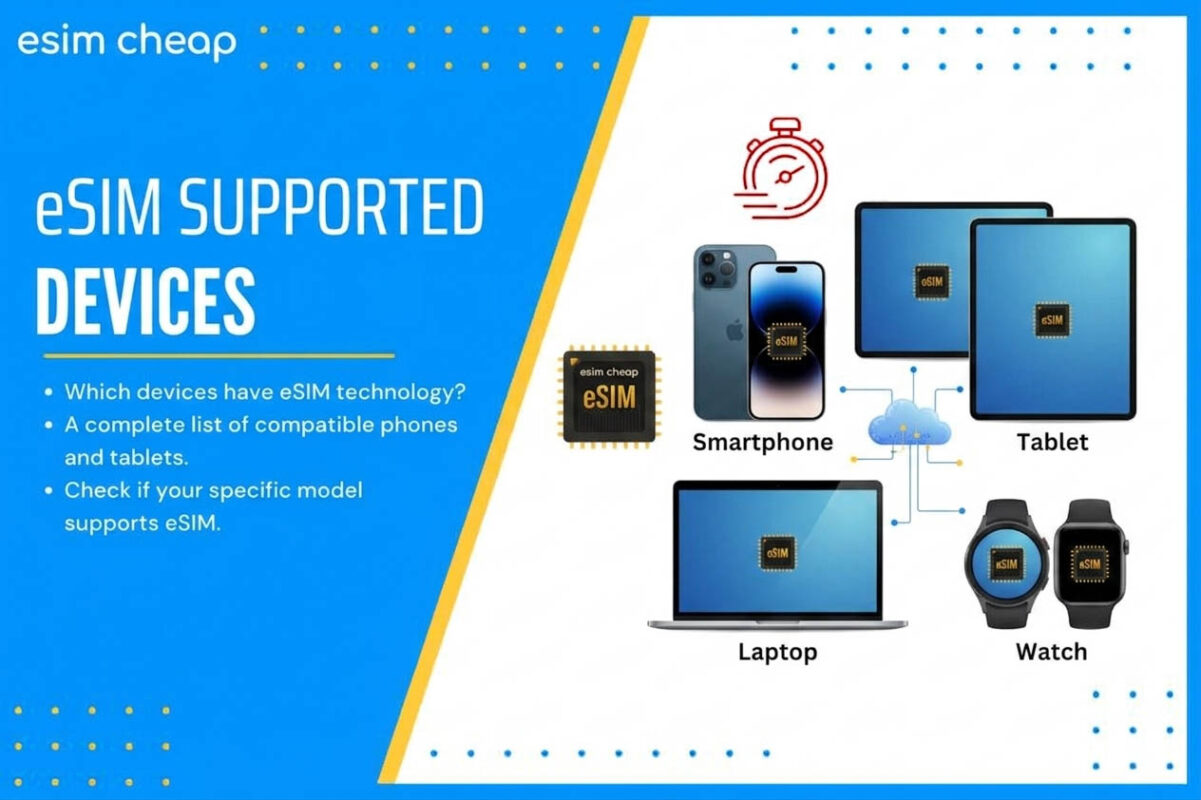
Find out if your phone supports eSIM technology with our full updated list of eSIM compatible phones and supported devices (tablets, smartwatches and laptops). Important: To use an eSIM, your phone must be carrier-unlocked and eSIM-compatible. In this list, you will know: Which iPhones support eSIM Which Android phones support eSIM (covering Samsung, Google Pixel, [...]
06/11/2025
Learn how to use eSIM on Google Pixel, including steps to install, use and convert eSIM extremely quickly and easily. eSIM is a technology first launched by Google through Google Pixel phones, starting in 2017. Although eSIM is gradually becoming popular with Vietnamese users, not everyone clearly understands how to use eSIM on Google Pixel. [...]
06/11/2025
Learn how to use eSIM on Google Pixel, including steps to install, use and convert eSIM extremely quickly and easily. eSIM is a technology first launched by Google through Google Pixel phones, starting in 2017. Although eSIM is gradually becoming popular with Vietnamese users, not everyone clearly understands how to use eSIM on Google Pixel. [...]
06/11/2025
06/11/2025
 Address: International Service
 Hotline 1:
  Email: